◆Tatsuzo Shimaoka(1919-2007)
He was a potter who was active from the late Showa period to Heisei period.He was born in Tokyo in 1919 (1919).
His father is Shimaoka Yonekichi, a braiding artist.This is an important development that led to the later rope patterns.While attending high school, he visited the Japan Folk Crafts Museum and became captivated by the beauty of folk crafts.After graduating from the Department of Ceramics at Tokyo Institute of Technology, he studied under Hamada Shoji and in 1953 opened a kiln in Mashiko, Tochigi Prefecture, and became independent.His father was a braid artist, and he established his own unique Jomon inlay technique, which involves filling in the impressions made by rolling braid on the surface of a vessel with decorative clay, and was designated a Living National Treasure in 1996.Tatsuzo Shimaoka's Jomon patterns are not simply pressed down on the rope, but are created by twisting and twirling it, and the subtle misalignment of the lines gives the work its charm.
In addition to these Jomon inlays, we have experimented with combining them with other techniques, such as creating white window paintings with red paint inside, or using blue and black clay for the inlays.In addition to these unique techniques, Shimaoka has also been influenced by his master, Shoji Hamada, and while he follows Hamada's style in using window paintings with white candles, glaze pouring, persimmon glaze and other iron glazes, and red-glazed brushwork, he has produced works with a unique worldview.
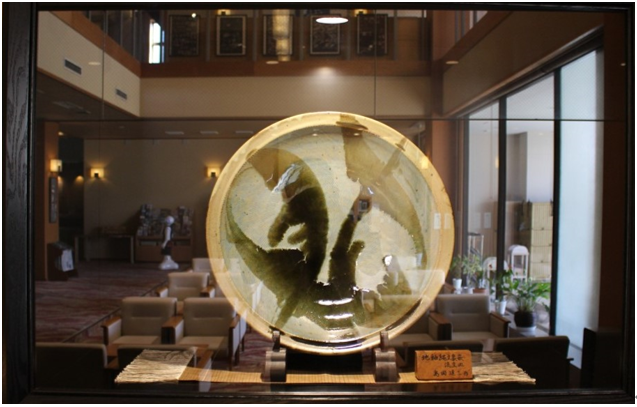
◆The large plate shown above, an ash-covered, flowing, Jomon, inlaid plate, is the largest plate that can be fired in a climbing kiln.This is a masterpiece that combines the Jomon inlay technique with the flowing water technique, which is also a specialty of Hamada Shoji.The pottery is fired near the entrance of the kiln, and in the high-temperature atmosphere of the kiln, which reaches nearly 1300°C, firewood ash falls onto the pottery and reacts with the feldspar in the soil, turning it into glass, creating the "ash coating."
◆The photo shows the exhibits installed in a display case in the lobby, which was created with the aim of creating a display space that rivals that of an art museum.In order to create an exhibition space that is as good as the artworks themselves, we have made numerous improvements to arrive at our current form.The interior is lit from three sides and is designed to fully showcase the appeal of any piece of artwork, regardless of its shape.(The exhibits change depending on the season.)