- Top
- A-03
A-03
*** Tatsuzo Shimaoka - Kiln-changed Jomon inlaid vase (Yohenjo Monzo Gattsubo) Commentary ***
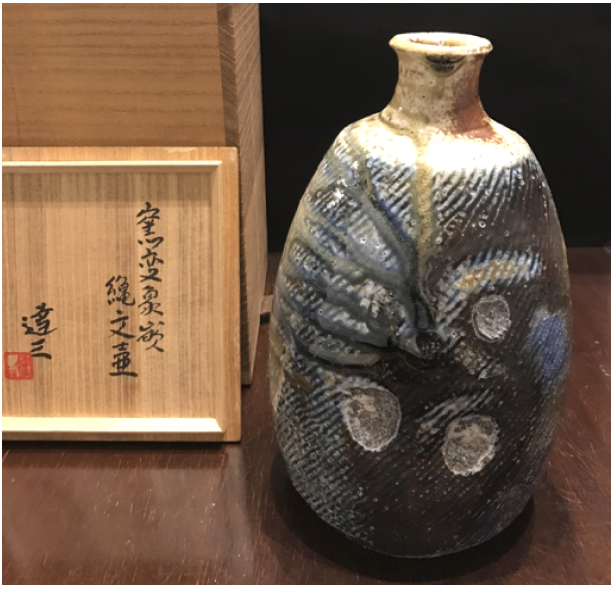
△ Kiln-changed Jomon inlaid jar (Yohenjo Monzo Gattsubo)( Pot height:26cm/ Written by Tatsuzo Shimaoka)
- ◆Tatsuzo Shimaoka(1919-2007)
After graduating from the Department of Ceramics at Tokyo Institute of Technology, he studied under Hamada Shoji and in 1953 opened a kiln in Mashiko, Tochigi Prefecture, and became independent.He established his own unique Jomon inlay technique, in which he rolled the braided cords of his father, a braid artist, onto the surface of a vessel and filled in the impressions with decorative clay, and was designated a Living National Treasure in 1996.Shimaoka Tatsuzo's Jomon works are not simply pressed with string, but rather the subtle misalignment of the lines created by twisting the string around gives the pieces a unique character.
◆What is "Kiln Change"?
Kiln change is a decorative technique for ceramics, and refers to the color change that appears on part or all of the pottery during firing.During firing, unexpected glaze colors and textures appear on ceramics due to the nature of the flame and the condition of the glaze, a phenomenon known as kiln change. This is a manifestation of the changing appearance caused by the kiln.Most "unglazed pottery" is fired without applying a glaze and is made using a technique called "yakishime," which simply involves firing the piece at a high temperature until it is hard. However, because it is fired at a high temperature for a long time, various changes occur depending on the state of the flame, and these changes become apparent in the pottery's character.
◆"Shell Remains""Glass beads"
When firing in a climbing kiln, when the internal temperature reaches 1200°C or higher, the wood ash reacts with the elements of the clay in the pottery, producing a natural glaze.The flow of the natural glaze changes depending on how the pottery is placed, creating a variety of different expressions.This item has four shell marks due to being placed horizontally.