
- Top
- A-04
A-04
*** Tatsuzo Shimaoka - Salt-glazed Jomon inlaid jar (Shiogusurijo Monzogantsubo) Commentary ***
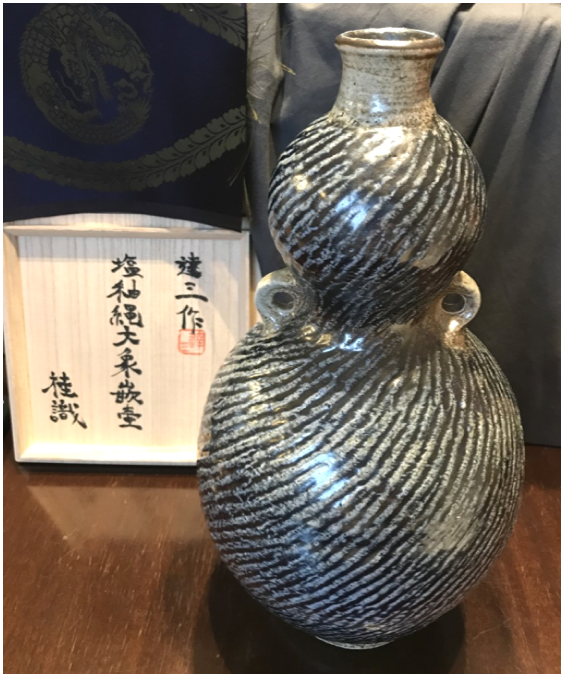
△ Salt-glazed Jomon inlaid jar (Shiogusurijo Monzogantsubo)( Pot height:33cm/ Written by Tatsuzo Shimaoka)
- ◆Tatsuzo Shimaoka(1919-2007)
After graduating from the Department of Ceramics at Tokyo Institute of Technology, he studied under Hamada Shoji and in 1953 opened a kiln in Mashiko, Tochigi Prefecture, and became independent.He established his own unique Jomon inlay technique, in which he rolled the braided cords of his father, a braiding artist, onto the surface of a vessel and filled in the impressions with decorative clay, and was designated a Living National Treasure in 1996.Shimaoka Tatsuzo's Jomon works are not simply pressed with string, but rather the subtle misalignment of the lines created by twisting the string around gives the pieces a unique character.
◆What is "Salt Glaze"?
Salt glaze is a decorative technique for ceramics that Hamada Shoji tried out on many of his pieces and perfected, and Shimaoka Tatsuzo inherited it.The technique involves adding salt to a kiln heated to 1300°C, and the soda gas released from the burning salt reacts with the silica in the clay to produce soda glass, which then creates a granular, glossy glassy coating on the surface of the vessel.However, the way Hamada and Shimaoka add salt is very different.While Hamada's method was to throw in large amounts of coarse salt wrapped in newspaper, Shimaoka came up with a method of placing the salt inside a bamboo stick split in half and inserting the bamboo into the kiln to scatter the salt.Whereas Hamada's technique has an irregular, wild quality, Shimaoka's technique produces a neat finish with uniform grain and color.Its refinement, combined with the Jomon inlay design, opens up a completely different realm from Hamada's salt-glazed works.